

There’s actually one for every letter of LGBT
Pretending that an era was jam-packed with great TV, films, music, or games just because you were a kid when they came out is obviously the result of the nostalgia devil whispering sweet nothings into your ear. However, even when you put nostalgia aside, it’s not hard to see that 2006 really was a remarkably good year for animation.
That year, we saw the release of multiple massive titles that have since become modern classics, like Satoshi Kon‘s hypnotically psychedelic Paprika and Mamoru Hosoda‘s sci-fi romance The Girl Who Leapt Through Time. Meanwhile, Studio Ghibli shared its rather unusual take on Ursula Le Guin’s Tales From Earthsea – although admittedly, to a mixed reception.
Things were similarly exciting when it came to TV, too. As a result, 2026 is crammed with 20th anniversary celebrations that make you feel yourself going just a little greyer with every day that goes by.
Something that really struck me while rewatching (or discovering) these series for their respective anniversaries was just how incredibly queer a lot of it actually was. So much so that it wasn’t hard to pick a series out for each letter of LGBT (besides the obvious fact that there’s naturally some crossover between each group).
We’ve tried to keep it to a minimum, but please anticipate light spoilers for each series included in this list. You have had two decades to watch them, though. Assuming you’ve been alive for that long.
Nana
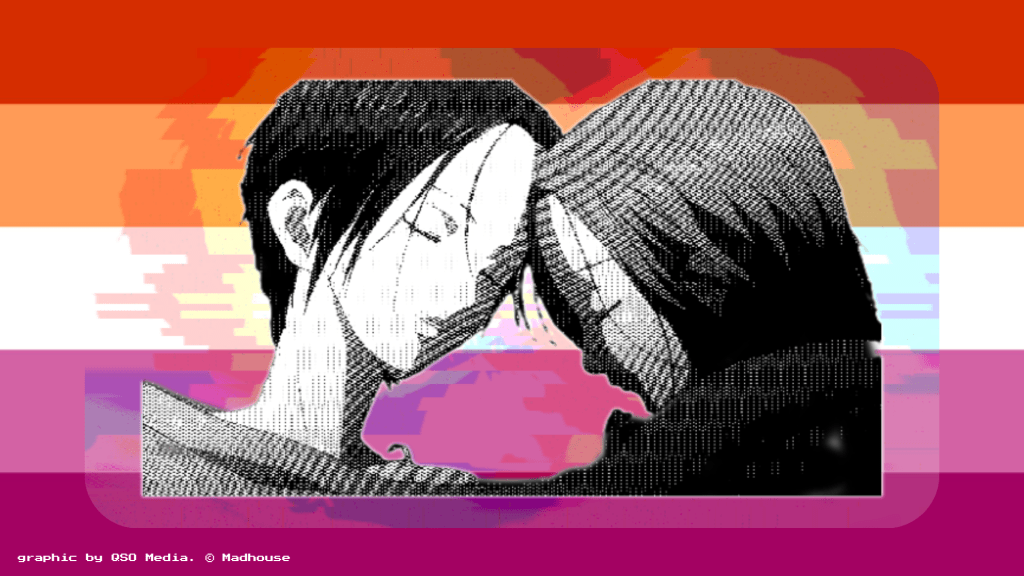
If an anime has music as one of the central themes, then it’s a pretty safe bet that it’s going to be gay, lesbian, or bisexual in one way or another. I mean, just look at Given, K-On!, or Bocchi The Rock!, for starters.
Thankfully, Madhouse’s sharp, music-infused romantic drama Nana is no exception to the rule. Underneath all of the spiked accessories and Vivienne Westwood chains hides a tender story about love, misogyny, and the consequences of compulsory heterosexuality.
Ai Yazawa’s Nana follows two star-crossed (and incredibly contrasting) young women who just so happen to share the same name. As they each embark on their new lives in Tokyo, on the same train no less, fate keeps pulling them together in increasingly strange ways – despite their frequent attempts to push one another away.
At the risk of sounding hyperbolic, Nana is one of those TV shows that’s an absolute must-watch. Presuming that you can cope with sitting through almost 50 episodes featuring disgusting men with long hair, that is. Personally, I had to take a brief break as it was giving me stress headaches, but I’m glad I watched it nonetheless.
For fans of: Alanis Morissette, juicy soap operas, alternative fashion, attachment theory, and those two houses that look like total opposites.
Death Note
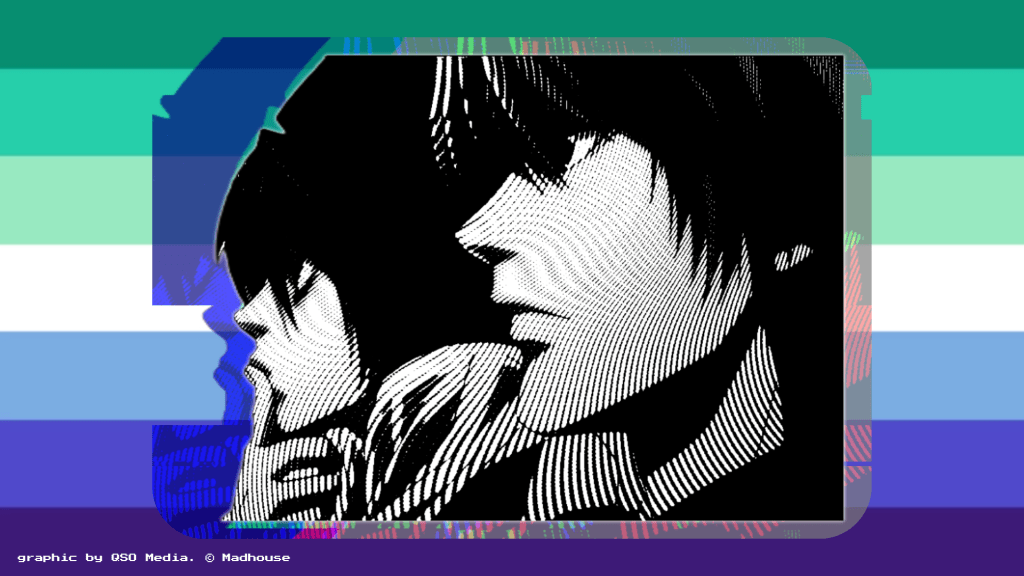
You probably already know this, but Death Note is a story about playing God, the policing system, and the death penalty. When a shinigami finds himself getting bored with his life in god-knows-where, he drops an otherworldly notebook with the power to control someone’s death. When the book winds up in the hands of self-proclaimed normal teenager Light Yagami (Mamoru Miyano/Brad Swaile), things go horribly wrong, incredibly quickly.
Look, if you go into watching Death Note expecting an out and out gay romance, then you’re going to be disappointed. But, despite what some sections of the internet may claim, Light Yagami and L Lawliet (Kappei Yamaguchi/Alessandro Juliani) certainly share a LOT of romantic tension. You can’t really miss it. In coming up with a cat-and-mouse dynamic that falls somewhere between Moriarty and Sherlock and Jesus and Judas, Tsugumi Ohba managed to cook up the biggest batch of yaoi cocaine you can imagine. And we, the audience, get to snort it all up.
For fans of: police procedurals, old-school DeviantArt, nu metal, and BDSM.
The Melancholy of Haruhi Suzumiya
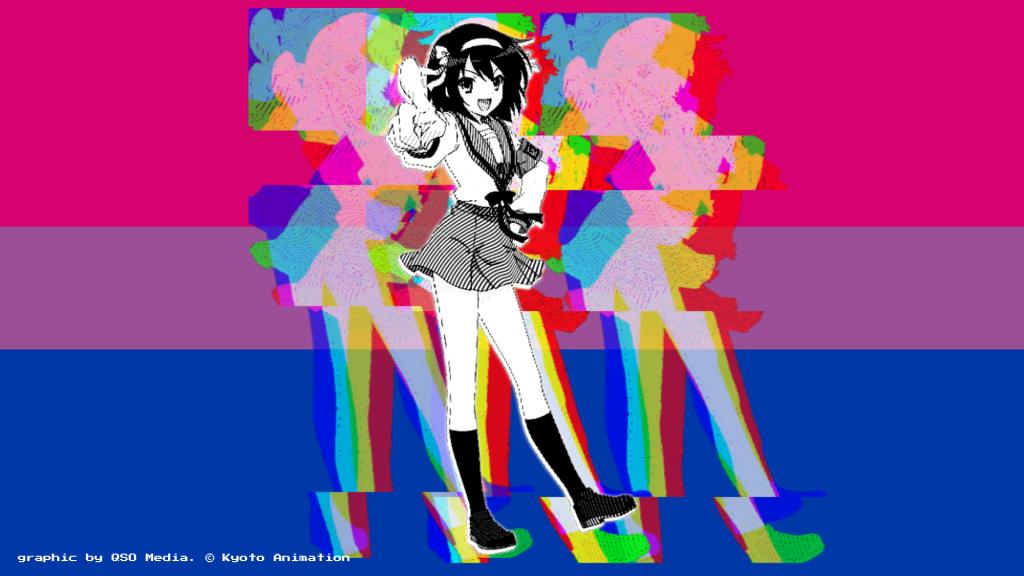
The Melancholy of Haruhi Suzumiya asks two very important questions. The first one is, what would the world look like if God were a teenage girl? And, the second – and perhaps more important question – is what would God be like if she were a bisexual control freak with a penchant for mischief, hijinks, and horseplay?
In case you hadn’t already guessed, the answer is that the world wouldn’t look so good at all. Not for the people closest to the titular Haruhi (Aya Hirano/Wendee Lee), at least. The long-windedly titled The Melancholy of Haruhi Suzumiya is a sci-fi coming-of-age drama about a girl who essentially forms a gay-straight alliance for all the mystical beings at her school.
The show was totally inescapable throughout the 2000s and early 2010s – so if you think you don’t know it, then maybe you just grew up in a slightly different timeline. Besides being culturally defining, Kyoto Animation’s megahit is also undeniably, unavoidably queer. Within the first few episodes (regardless of which order you watch the series in), Haruhi confidently shares that she’s interested in boys and girls – alongside aliens, espers, and time travellers, of course. I’ll try not to give anything away, but I think it’s safe to say that she isn’t the only queer at North High, either.
For fans of: flowery prose, frog costumes, Tomihiko Morimi, DanDaDan, and being gay/doing crime.
Ouran High School Host Club
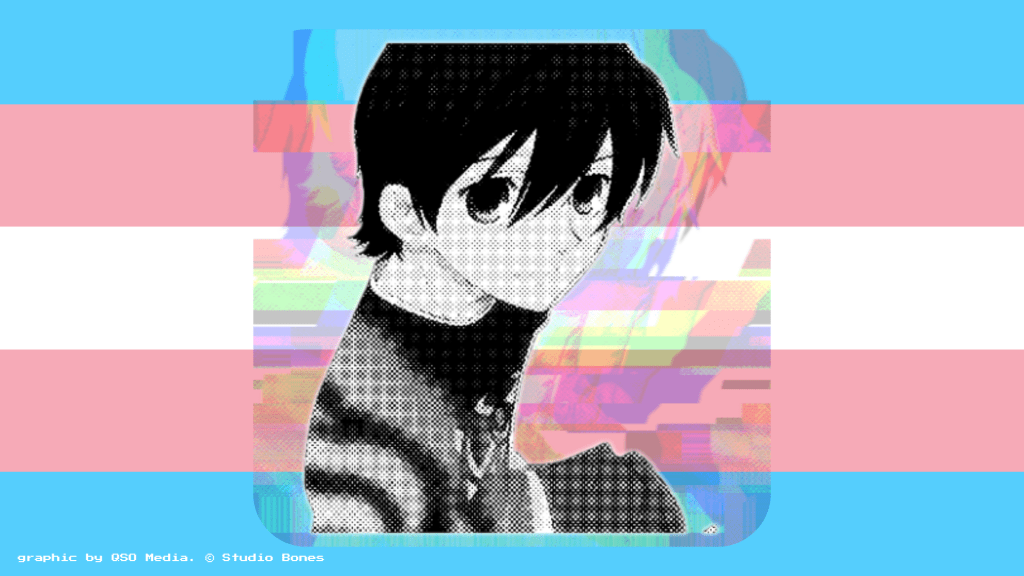
I won’t lie: Ouran High School Host Club is an offensive nightmare. However, it’s also a remarkably apt portrayal of navigating life as an eggy trans teenager, despite… Literally everything about it. It achieves trans-icon status mostly despite itself, basically.
Ouran High School Host Club has a simple but bizarre premise. The extremely normal, chronically depressed, and latently queer Haruhi Fujioka (Maaya Sakamoto/Caitlin Glass) lands a scholarship at an elite school. While exploring the school grounds, Haruhi finds a seemingly abandoned music classroom where the school’s host club is squatting – and smashes a supposedly valuable vase worth around 8,000,000 yen.
As a result, poor Haruhi lands in an enormous amount of debt to the school’s host club. Without the financial means to pay the club back, one solution is, inexplicably, the only option: Haruhi must “pretend” to be a boy while working as a host to repay them.
I’m not even going to bother explaining why this one’s queer. Figure it out. Like Haruhi does.
For fans of: John Waters, low-res videos of conventions from the 2000s, thinly veiled gay romance, and forcefeminising-forcemasculinising someone back and forth fast enough to give whiplash.
Toni Oisin H.C. is the Head of Audio at QSO Media. Read more of his writing here.
We Exist is a Trans collective and mutual aid group offering peer support within the community. You can support them here.
Enjoy QSO Media’s content? Support alternative LGBTQIA+ journalism by buying us a Ko-Fi.
 QSO Media